New publication highlights the role of eInclusion actors on improved digital literacy in the European Union

November 14, 2013

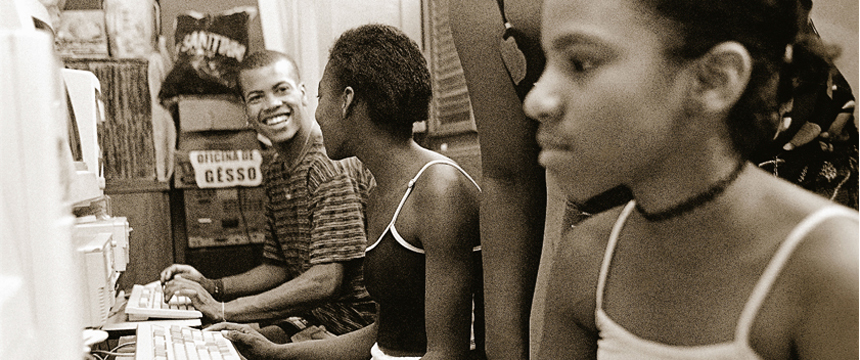
eInclusion – access to ICTs, ICT skill development, and digital literacy – is becoming increasingly important in both developed and developing contexts for social and economic participation. Strategies for shared access (telecenters, libraries, cybercafes, etc.) by eInclusion actors are particularly important for including marginalized populations. Successful investment to support eInclusion actors requires an understanding how venues operate. Commissioned by the European Union’s Joint Research Centre Institute for Prospective Technological Studies (IPTS), Telecentre-Europe and the Technology & Social Change Group conducted an online survey aiming to provide a ‘map’ of telecentres, libraries, and other eInclusion actors operating in the European Union (EU). The report presenting the findings of this survey, the first of its kind in Europe to collect data from eInclusion actors, is now available.

The role ICTs and libraries play in emergency situations

November 5, 2013

The use of ICTs, such as mobile phones, text messages, and various applications, increases with every emergency situation and disaster we see. The organization Libraries Without Borders (Bibliothèques Sans Frontières) recently held an international symposium, The Urgency of Reading, which brought together experts from all over the world to discuss innovations and good practices in providing access to information, ICTs, and culture in emergency humanitarian situations. Among participants from the United Nations, UNESCO, and various humanitarian foundations, TASCHA’s Maria Garrido was invited to discuss her research on the role of public access ICT venues, such as libraries and telecenters, in the aftermath of the 2010 earthquake and tsunami in Chile. Maria presented the main findings of this research, as well as the recommendations based on the findings. Maria focused particularly on the importance of the physical space libraries provide in the aftermath of disasters.

Innovation Spaces: From access to information to access to each other

October 22, 2013

Innovation Spaces: From Access to Information to Access to Each Other was the topic of a presentation delivered by TASCHA Director Chris Coward at Cotexto Digital in Bogota Colombia, October 17, 2013. Contexto Digital is a series of events organized by the National Library of Colombia and the Luis Angel Arango Library of Colombia aimed at addressing various topics at the intersection of digital media, culture, and development.

Misconceptions and mistakes: What if our approach to technology in libraries, telecenters, and cybercafes is all wrong?

October 5, 2013

Join the Global Impact Study team at USC’s Annenberg School on Monday, October 7, for a review of what they learned, and to discuss how their findings should shape ICTD policies and programming in the years to come. If unable to attend in person, please follow along on Twitter at @TASCHAGroup.

Event recording: What is TASCHA & the US IMPACT Study

October 3, 2013

On October 2 Rebecca Sears and Samantha Becker presented an overview of TASCHA and the US IMPACT Study for UW students. Students who attended learned about the effects of technology on economic and social development, open data and open research, public access to technology, digital inclusion, impact and evaluation, and access to information, communication, and…

TASCHA Director to participate in European Congress on E-Inclusion

September 25, 2013

TASCHA Director Chris Coward has been invited to present at the 5th Annual European Congress on E-Inclusion (ECEI13) on October 3, 2013. This year’s event, “Building an Inclusive Digital Europe,” will bring together over 100 stakeholders and thought leaders from the public policy, private, not-for-profit, and community sectors in Brussels. Chris will draw on TASCHA’s research to participate on a panel presenting evidence on the role of intermediaries, particularly public libraries, in digital inclusion, skills development, and opportunities for socio-economic empowerment and employability. Chris will present findings from TASCHA’s Global Impact Study of Public Access ICTs and the U.S. IMPACT Study’s Opportunity for All report.

Event: What is TASCHA and the U.S. IMPACT Study? An introduction to our research and people

September 20, 2013

Are you interested in the effects of technology on economic and social development? Do you wonder if mobile phones will replace PCs? Curious about open data and open research? Passionate about access to technology, communication, and information resources? Well, we have a great event for you! Come learn about us and the U.S. IMPACT Study on October 2, 2013! At this event, we will introduce TASCHA and the U.S. IMPACT Study, two research groups focused on issues like digital inclusion, impact & evaluation, and access to information, communication, and technology resources.

New publication: Public libraries connecting people for development

August 13, 2013

Last month, we released the final report of the Global Impact Study of Public Access ICTs, Connecting people for development: Why public access ICTs matter. In addition to the overall analysis presented in the final report, TASCHA researchers also conducted analysis specifically related to ICT access in public libraries in Botswana, Chile, and the Philippines. The report based on this analysis, Public libraries connecting people for development: Findings from the Global Impact Study, is now available for download. Using data from Botswana, Chile, and the Philippines, the report summarizes the study’s key findings with a focus on libraries, situating these venues in the context of national development, discussing some disputed issues, and providing recommendations for policymakers, library practitioners, and researchers.

The roles of Facebook in the Egyptian Arab Spring

July 9, 2013

I recently presented a paper on the different roles of Facebook during the Egyptian Arab Spring at the International Conference on Social Implications of Computers in Developing Countries (IFIP) 2013. This conference is one of the most important spaces to critically discuss the social implications of Information and Communication Technologies (ICTs) in developing countries. IFIP not only brings together scholars, practitioners, and policymakers from different parts of the world, but also provides a multidisciplinary and multicultural space to discuss, plan, and work on theoretical, methodological, and practical challenges that ICT for development faces. IFIP 2013 focused on outlining crucial future challenges for the area, gaps that have not been addressed sufficiently, new technological possibilities, better understanding of institutional dimensions, and critical reflection on methodological approaches and theoretical positions that may guide our future thinking.

Global Impact Study: Final report & findings released

July 2, 2013

While you’re likely reading this on your personal computer, enjoying reliable and fast internet, millions of people around the world still lack private access to this increasingly necessary resource to function and prosper in today’s world. How do those people connect to digital society? For many, digital inclusion is found at a library, a telecenter, or a cybercafé – their local public access ICT venue. For over a decade, significant investments have been made in these venues. However, their ability to contribute to development agendas has come into question in recent times, spurred by the spread of mobile phones and other new technologies and applications. The Global Impact Study was designed to address this debate by generating evidence about the scale, character, and impacts of public access ICTs.
Today, TASCHA is excited to announce the release of the study’s final report, Connecting people for development: Why public access ICTs matter.